
 Sam
remembered. Sam
remembered.
|
------------
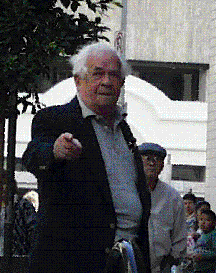
11:49 p.m. If you saw this kindly looking round man pointing at you on the street, what would you think? That your hair's a mess, you shirt's askew? A normal, self-centered reaction. Or maybe, maybe he's not pointing at you at all, but at something behind you -- maybe there's a robbery in progress, or a fire. Again, a normal reaction. You might even turn to look behind you. But if you knew Sam Goldberg, really knew his story, this simple gesture would fill you with absolute, dreadful terror. Because Sam had a mission, a strong, single-minded goal: to point to the truth. No matter how horrible. Until it set him free. We met Sam because we are book packagers and we work every day with people who have stories to tell. Packagers provide the glue to hold a project together and get it ready for the publisher. Since manuscripts come to us in various stages of array and disarray, sometimes we do the heavy lifting and sometimes we just help with a polish. Sometimes we can't bring a project to life no matter how many rewrites or points of view we try, and sometimes ... sometimes there's a man like Sam. With Sam, you turn on the tape recorder and hi-8, hang a spot behind his white halo of hair, check the light meters and sound levels, and just let him talk. And talk. He will make you laugh, of course, because he was once a Polish stand-up when the shoe was on the other foot and they were the ones making the jokes. Because he's also Jewish, he will naturally weave you a story with plenty of schmaltz to melt the toughest heart, and because he was once the Deli King here in California, there will be enough wry wit sprinkled through and through to satisfy the most demanding tastes. But he was also a resident, for a time, in hell. And that part of the story is hard to listen to. When we were filming Sam a few months ago, it was a beautiful Sunday afternoon. Film and book people were milling around a lavish luncheon spread and only half-listening to Sam's voice as the taping was getting under way. A question would be asked, a scrapbook brought to the table, another bagel generously slathered, and Sam would remember more details from when he was a kid. His dad had a brewery. He had a sister. He got deathly sick once, and his relatives worried and prayed. The same old simple stuff that all our lives are wound tight with, tales told and retold, the words now efficiently spinning away on shiny mylar tape so they can be unwound and rewound and spun again. And then, suddenly Sam would remember something else and he would say it and it was as if you had just bit down, hard, on your own tongue. An unexpected pain that takes your breath away and makes you put aside your food. Makes you weak in the knees. Makes you sick in the stomach. But you listen. Sam knew he wouldn't die in the camps. He knew he was going to go on, afterward, carrying the memory into the future, bearing the heavy weight of witness for many long years. That burden was lifted from him yesterday, when he died. Some of his story is in the permanent archives of the Holocaust Museum, in his own words. The rest of the story is on tape now. It's hard to listen to, but you listen. Because you must. Because it's the truth. Because Sam must remember. And you must not forget. |
• email • Street Mail • Shadow Lawn Press • archives • index •
 •
yesterday
•
July
• tomorrow
•
•
yesterday
•
July
• tomorrow
•
-- all verbiage © Nancy Hayfield Birnes --