
 Welcome
to the other side
of the
screen.
Welcome
to the other side
of the
screen.
|
------------
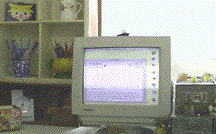
1:27 p.m. Here is my space. Since nobody's beating down the door to come and visit, I thought I'd just bring the space to you. Not that I'm complaining; not that I'm distressed. Not at all. The thing is, I think the counter on the bottom of my page is busted. I'm going to fire off an email to the good people at Links-a-lot and tell them to check their equipment. Meanwhile, here is where I work and where I used to play computer games, carefully honing my Snood-shooting skills and laboriously stacking colored cubes atop one other. Now, it's all work work work. Do a little sentence, change a coupla commae, work, work, work. Notice that the piddly 640x480 screen containing my beloved HyperCard has a soft yellow background? That's a simulated legal pad that I created pixel by pixel myself, and there's a neat row of icons down the right side of the screen. I've got a major icon collection, organized by subject, that I'd be more than happy to share -- just ask. For some reason, the perfect visual representation of a concept seems so comforting, so oddly important. Take my games folder, for instance:
It's Bill the Cat. Perfect. And that's that. Once you find the right one, you stick with it. To fuss and fiddle overmuch would be weird, of course, and we don't want that. No -- it's just a matter of getting comfortable with your space, your tools, your surroundings. Readers of The New York Times who are also writers probably read the piece in yesterday's paper by Mary Gordon, about just this very subject. In the article, she describes her lifelong love of pen and paper and her delight in the perfect journal with raspberry trim from Trastevere, the perfect paper handmade in Vermont; the perfect point to her nib. And if you've ever faced the blank-faced horror of the unwritten word, you know how important it is to surround yourself with things that comfort, things that sustain, things that don't insult. It's one of the classic secrets of this arcane trade. Most writers, before they mention the cool but edgy music they love and the sorry condition of their bathrobes, will always tell you that Schiller couldn't write unless there were rotting apples in his desk drawer. Whatever makes it easier -- the smell of decay, the stack of foolscap, or the squeak of a sharpened number 2. And speaking of bathrobes: I can tell you that the great John McPhee told me that he has actually tied himself to his desk chair with his bathrobe belt. When you're that good, it's that hard. So I wish writers who have found their favorite dependable, expendable goodies would stop taking potshots at writers who use a different stylus. Mary Gordon ends her article with a typical snipe: "I don't know what people who work on computers do to get themselves started. I hope never to learn firsthand." Makes me mad, I tell you. Makes me mad. I'm old. I've been there. I've lost peacock-blue poems to the rain. My first columns were pounded out of a big black manual typewriter and poured out of hot metal, so don't tell me how fey it is to work with luminescence instead of lead. If the words have life, the matter of their mother doesn't mean that much. Sure, sure. The hum of the old Smith-Corona is ominous. Yeah, yeah. But just try staring down the silent blinking slash slash slash of the cursor that never slash slash -- never -- gives you a clue. The damned unnatural mute tap-tap-tap of its never-ending, ever-demanding heartbeat, sucking up your words the second you type them, never satisfied, always wanting more slash slash more ... Tomorrow -- more -- slash slash. |
• email • Street Mail • Shadow Lawn Press • archives • index •
 •
yesterday
•
July
• tomorrow
•
•
yesterday
•
July
• tomorrow
•
-- all verbiage © Nancy Hayfield Birnes --
