
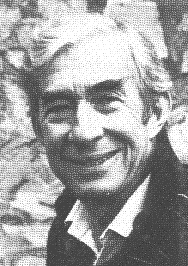
 William
Goyen
William
Goyen
"... and then I walked and walked in the rain that turned half into snow and I was drenched and frozen; and walked upon a park that seemed like the very pasture of Hell where there were couples whispering in the shadows, all in some plot to warm the world tonight, and I went into a public place and saw annunciations drawn and written on the walls. I came out and felt alone and lost in the world with no home to go home to and felt robbed of everything I never had but dreamt of and hoped to have; and mocked by others' midnight victory and my own eternal failure, unnamed by nameless agony and stripped of all my history, I was betrayed again." |
------------
12:21 p.m. I said yesterday, with great confidence, that life is fair. I really believe this, but sometimes I can't see it. My angle, after all, is skewed to the insignificant, diffracted by self-absorption. I am a writer, a sensitive writer with the thinnest of skins -- an inadequate membrane when it comes to letting slurs and slings and other sharp things bounce off. People can really be creepy sometimes. But, I've got ammo, too. Here's where some of it comes from. I was lucky enough to have had a few great teachers. It's funny the ones who made an impression, and why. I tend to remember acts of incredibly cruelty or kindness, teachers who went way, way out of their way. In the beginning of my career behind desks, of course, there were the nuns. I don't know what the teaching nun of today looks like, but back when I was the second shortest kid in my class, the nuns were truly, spectacularly medieval. They even smelled brimstone black, baizey, moldy. They didn't walk; they swirled around you. They wore white fabric starched as hard as Formica around their faces, causing their cheeks and chins to dimple and their unwrinkled brows to stretch to Mt. Rushmore-heights. Plus, there was always a metal crucifix the size of an ornamental sword thudding against their padded thighs. The earliest lessons sometimes last the longest. We were told that if God stopped thinking of us for just one second, or if we uncrossed our hands from the edge of the desk, or talked when Sister Mary Martha left the room, we would turn into pillars of salt. My first grade teacher kissed my cheek the first day of school, soft as a moth. She gently waved to the window and said it was the right. I knew how to sit still, and life was good. In second grade, things got turned around, literally, and we were in a room on the other side of the blackboard. The little monster nun we were afflicted with wouldn't let you raise your hand to ask a question. You had to be called upon. We always had to pass loose-leaf paper to the back of the room, without looking, so she could mop up the mess made by the boy who wouldn't wait his turn to go to the bathroom. Worst of all, the window and the door were reversed and now the window was no longer right, and since you couldn't ask questions, I never figured out what happened.
I've always believed in waiting your turn, going where the day takes you, sitting in whatever seat is available, without fuss. Usually the seat is empty because it's the one beside the crazy person. And that's how I came to sit beside William Goyen on the first day of class -- the new students had left a wide berth in the circle of arranged chairs, and I was late, as usual. I cluttered my things to the floor and was in the act of grabbing my notebook when I saw his boots: red embroidered cowboy dandy boots, impossibly red. Slowly, my eyes traveled up the man, whom I now recognized as The Teacher, and they came to rest on the most bizarre bushy eyebrows I'd ever seen. He was smiling, of course, because he was always smiling, but you knew that nobody normal would ever have such exultations on their face. In that first class meeting, a student asked him how you figured out what you should be writing about. It's one of the big questions, and we expected a big answer. Instead, he smiled. He told us it didn't matter what you wrote about -- it only mattered how deep you held it. He placed his hand parallel to the floor, above his red boots, and we all looked and looked, but what was there to see? No use in asking. It's taken me years to figure that one out. But the biggest lesson I learned from him was this: be nice. Just that: be nice. In this most competitive of professions, you've got to learn how to bide your time. Sometimes the other guy is going to get all the honors and all the attention. And sometimes, as in the case of Thomas Harris, his own pasta chef, flown in special so he wouldn't starve in the heat of composition, compliments of a big Hollywood producer. Flown in from Italy. Be nice. Don't kill a soul. Find something to praise in the lowliest pile of goo that crosses your desk. Wormy writers sometimes turn into butterflies. Who really knows what's right? So what if the worst screenwriter will always drive the best bargain? Wave to him as he speeds away in his big brown Miasma. Be nice. Sometimes the least needy are treated with the biggest baskets of fruit. If you sit still long enough and keep your fingers crossed just so, your turn will come. It will. I believe that. Bill Goyen was a truly great man. A great writer -- it goes without saying. If you were lucky enough to have heard him perform or lecture, you'd never forget the sound of his voice. It comes back every time I read his lilting, twangy, East-Texas language. If life were more fair, he'd be more well known. But because life is fair, he will never be forgotten. Tomorrow -- yeah, yeah, I know. |
|
|
|
• email • Street Mail • Shadow Lawn Press • archives • index •
 •
yesterday
•
July
• tomorrow
•
•
yesterday
•
July
• tomorrow
•
-- all verbiage © Nancy Hayfield Birnes --
